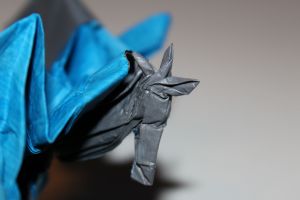
Scaled Works of Satoshi Kamiya 2 11-12

Origami, Scaled Works of Satoshi Kamiya

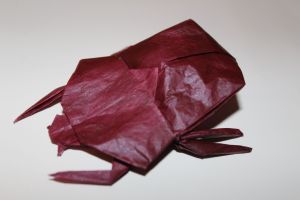
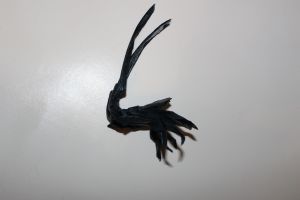
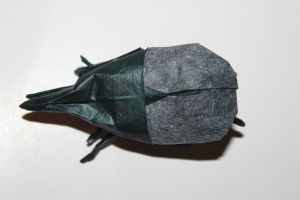
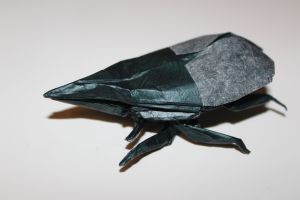
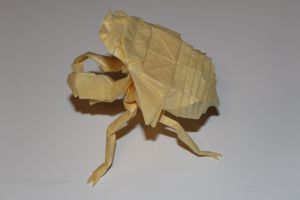
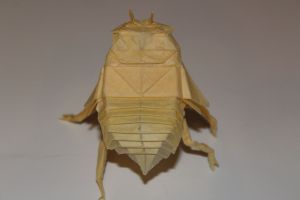
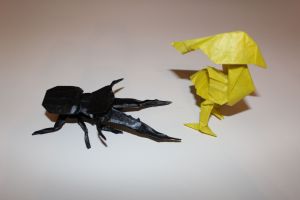
The next two Kamiya Works 2 models are both bugs but quite different from each other. Scaling is 27.9 cm an edge. I feel remiss when I don’t mention that.

WOSK_211 - CICADA NYMPH (2) WOSK_211 - CICADA NYMPH (3) WOSK_211 - CICADA NYMPH (4) WOSK_211 - CICADA NYMPH (5)

First up is the Cicada Nymph. I didn’t think I’d enjoy folding this model much (mainly because it’s a cicada) but I probably had more fun with this than any other model in this book. It has lots of features, is very well proportioned, and looks great. It doesn’t make me want to find out more about cicadas, but I’ll probably make this model again sooner or later.

WOSK_211 - CICADA NYMPH (1) WOSK_211 - CICADA NYMPH (6)

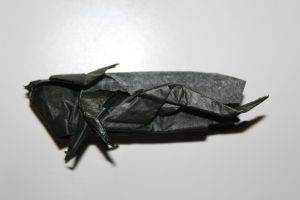
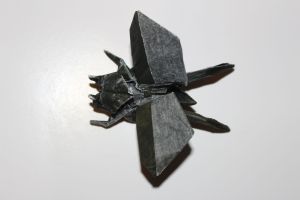
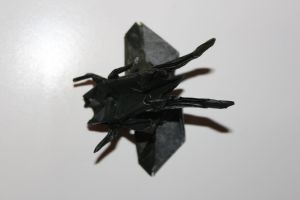
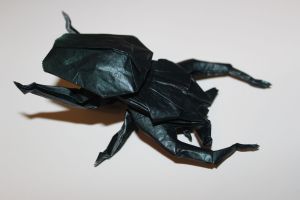
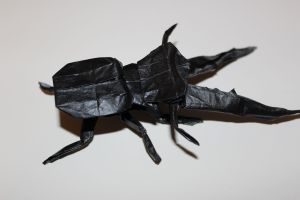
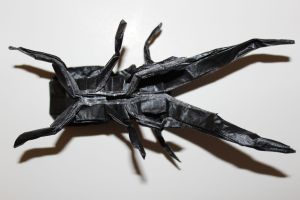
WOSK_212 - CYCLOMMATUS METALLIFER (1) WOSK_212 - CYCLOMMATUS METALLIFER (3) WOSK_212 - CYCLOMMATUS METALLIFER (4) WOSK_212 - CYCLOMMATUS METALLIFER (2)

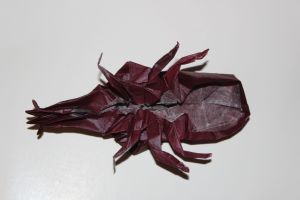
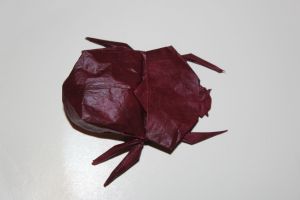
Our other bug is the Cyclommatus metallifer, a type of stag beetle. Were there a series of tiny beetle car crashes that eventually caused these beetles to adapt their mandibles into the Jaws of Life? No, that’s not how evolution works. Kamiya’s Cyclo-beetle-dude has the little spines on the inner jaws and the curve on the outer part of the jaws.

WOSK_212 - CYCLOMMATUS METALLIFER (6) WOSK_212 - CYCLOMMATUS METALLIFER (5)

I just had a lot of bugs in the last one. Is having more bugs here good for a thematic connection, or is it annoying with the overbugging?

Crease Pattern Challenge 014

Crease Pattern Challenge, Origami

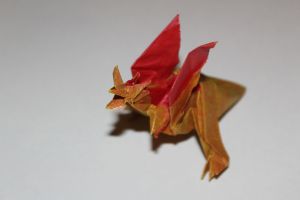
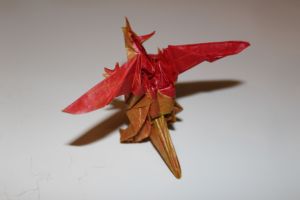
The Dragon by Seiji Nishikawa is Tanteidan’s Crease Pattern Challenge #14. You might be thinking, “Wasn’t that challenge #6?#6 was “Ryuu” (龍), an eastern style dragon with the Japanese word for dragon, and this one is “Dragon” (doragon/ドラゴン)  , to indicate a more western style. He is also more of a cartoon dragon, because he stands upright, like Charizards, Great Dragons, or Ice Dragons.

This crease pattern actually leaves out quite a few details, but that’s kind of a necessity because the folds double back quite a lot. That is, with all the details it would be a tangled mess to figure out, but, after folding the crease pattern for the initial shape, it should be easy enough to figure out with the final picture. Naturally, I first folded this without looking at the picture.

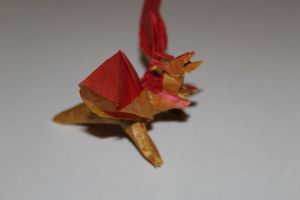
OTMCP_014 - DRAGON - NISHIKAWA (103) OTMCP_014 - DRAGON - NISHIKAWA (104) OTMCP_014 - DRAGON - NISHIKAWA (105)

He came out longer and more wyvernish than the original. While looking back at the final model during folding, I got:

OTMCP_014 - DRAGON - NISHIKAWA (106) OTMCP_014 - DRAGON - NISHIKAWA (107) OTMCP_014 - DRAGON - NISHIKAWA (108) OTMCP_014 - DRAGON - NISHIKAWA (109)

These make his body look more like the wyvern, but that’s only because the legs keep spreading from the center. Most of the features are very different, especially the head, which has eyes and a horn now. In any case, this illustrates the stylistic range you can get out of this crease pattern, and that’s pretty cool.

I also folded this one from diagrams in Works of Seiji Nishikawa, but that was a while ago. I have one that’s red (but only pictures) and one painted like the crease pattern ones. I wasn’t sure these were this dragon until I folded the crease pattern one. This is because of the tiny arms. I’m not a fan of these arms. T-rexes have bigger arms.
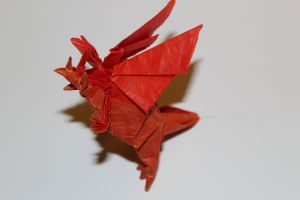
OTMCP_014 - DRAGON - NISHIKAWA (101) NISHIKAWA - DRAGON - WORKS OF(102) NISHIKAWA - DRAGON - WORKS OF(101) NISHIKAWA - DRAGON - WORKS OF(103)

For some other Nishikawa models, I thought it would be neat to do some other fantasy creatures, like his Pegasus, or Godzilla. But, since I already did that with the last Nishikawa crease pattern, I’m just going to do his half of Origami Insects Vol. 1.

Fumiaki Kawahata did the first half of this book’s models, and Nishikawa did the second. There are 8 total, so I’m just going to list them and show them in order.

Japanese Horned Beetle – Male
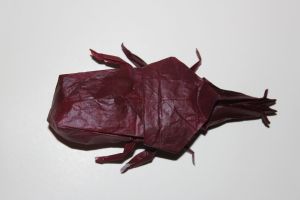
OI1_10 (101) OI1_10 (103) OI1_10 (104)

Japanese Horned Beetle – Female

OI1_11 (102) OI1_11 (103) OI1_11 (104)

Asiatic Locust

OI1_12 (101) OI1_12 (102)

Flying Asiatic Locust

OI1_13 (101) OI1_13 (102) OI1_13 (105)

Long-Horned Beetle

OI1_14 (101) OI1_14 (102) OI1_14 (104)

Lucanus Stag Beetle

OI1_15 (101) OI1_15 (103) OI1_15 (105)

Goliath Horned Flower Beetle

OI1_16 (104) OI1_16 (101) OI1_16 (103)

Hercules Giant Beetle

OI1_17 (101) OI1_17 (103) OI1_17 (104)

Additionally, Kawahata did something pretty cool with his models that weren’t included on Nishikawa’s. Taking the edge of a square as length 1.0, he showed each model next to a scale as a fraction of this. That way, you’ll know the size of insect you’ll end up with. Similarly, I took end model scans of each Nishikawa insect to show the scales of the models I got below.
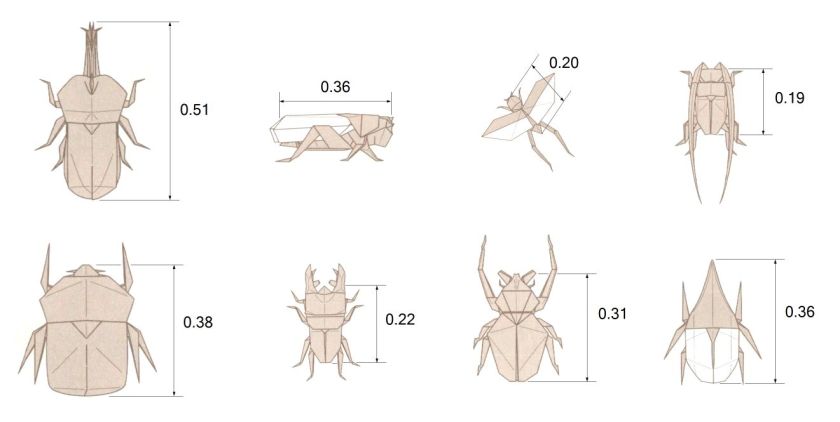
OI1_SN_10-17

Scorpion

Origami, Original Designs

I wanted to do the next Crease Pattern Challenge next, but, after I finished it awhile ago, I only took a couple of pictures that are a bit blurry. Sometime between then and now, I lost the model. So I’ll have to whip it up again. Instead, I’ve got something I came up with.

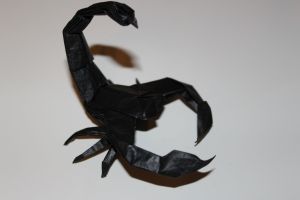
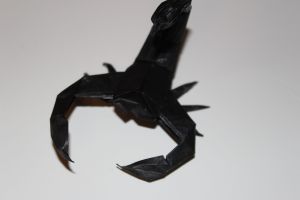
WKO_015 - SCORPION (101) WKO_015 - SCORPION (104) WKO_015 - SCORPION (103)

WKO_015 - SCORPION (105) WKO_015 - SCORPION (106)

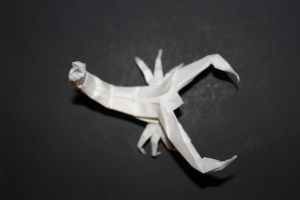
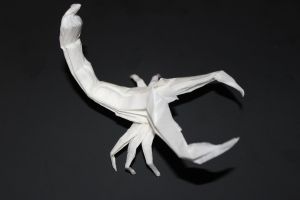
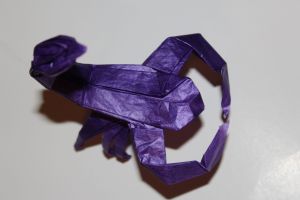
This Scorpion is another one of those models that just kind of clicked. I had been working with this base pattern a lot, and I just thought, “Hey, scorpion”. It is an extremely simple model but still looks really good (I think). Again, I figure others have come up with a similar scorpion due to its simplicity. Hopefully, this does not lead to some kind of vendetta, like in Kill Bill, Titus Andronicus, or Attack of the Killer Tomatoes.

WKO_015 - SCORPION (110) WKO_015 - SCORPION (109)

WKO_015 - SCORPION (107) WKO_015 - SCORPION (108)

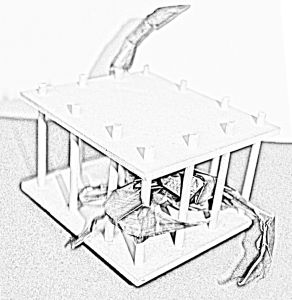
I was also going to use this scorpion for the logo. I have it in a wooden cage in the picture below and changed it to grainy black and white (shown below). I liked it because it wasn’t immediately clear what it was, but I ended up going with the exact opposite in a stark cartoon scorpion outline thing.

logo1


UPDATE YO:

When I first made this scorpion, I thought it looked a bit similar to a scorpion I’d seen before, but I couldn’t find it anywhere. I was organizing stuff and noticed a previous post here with random models.  It was this scorpion by Robert Lang from The Complete Book of Origami. Yes, I had folded and put it in a previous entry and still couldn’t find it. I actually searched for “Robert Lang origami scorpion”, but he has gone on to bigger and better scorpions.

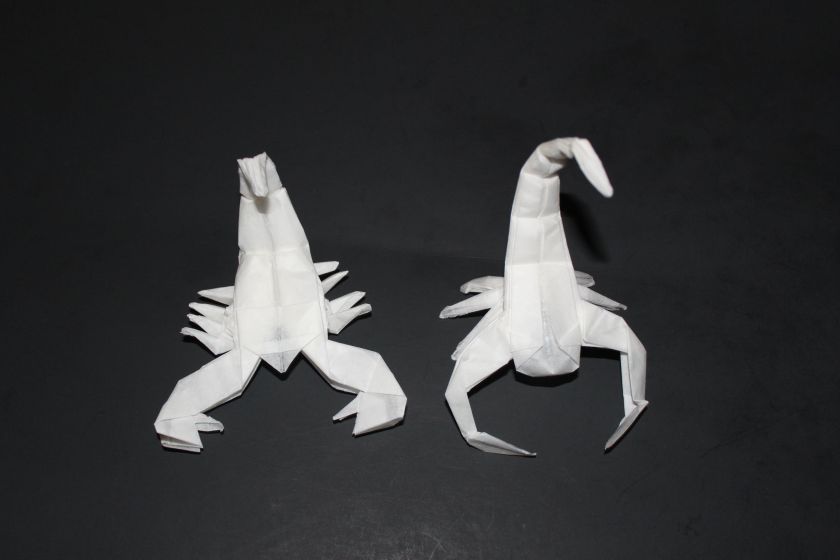
So, I folded them both at the same scale to compare. I don’t think they’re too similar. The similar feature is the tail, which radiates out from the dead center of the square in both models for length. The arms, legs, and head are completely different. However, the tail is such a prominent feature they do look similar.

WKO_015 - SCORPION (201)

The biggest difference between them is that I didn’t realize there is a difference between legs and arms in arachnids. Specifically, it’s not “eight limbs”, so a scorpion has both eight legs and two arms. You’ll notice, Lang’s scorpion is a scorpion, in that it has eight legs and two arms with pinchers. Not only does mine have only six legs, the arms don’t have pinchers. I know I google imaged “scorpion” while making this, so I’m really not sure what happened. Since the arms were a little long, I decided to pull some legs out of them.

WKO_015 - SCORPION (203)

I have the initial attempt above on the right, lined up with my original on left and Lang’s in the middle. Below is the updated scorpion.

WKO_015 - SCORPION (206) WKO_015 - SCORPION (207) WKO_015 - SCORPION (208) WKO_015 - SCORPION (209)

Scaled Works of Satoshi Kamiya 2 08-10

Origami, Scaled Works of Satoshi Kamiya

There are 3 models this week from Works of Satoshi Kamiya 2 (with squares of 27.9 cm a side), as two of these models are pretty similar.

WOSK_208 - TURBAN SHELL (1) WOSK_208 - TURBAN SHELL (3)

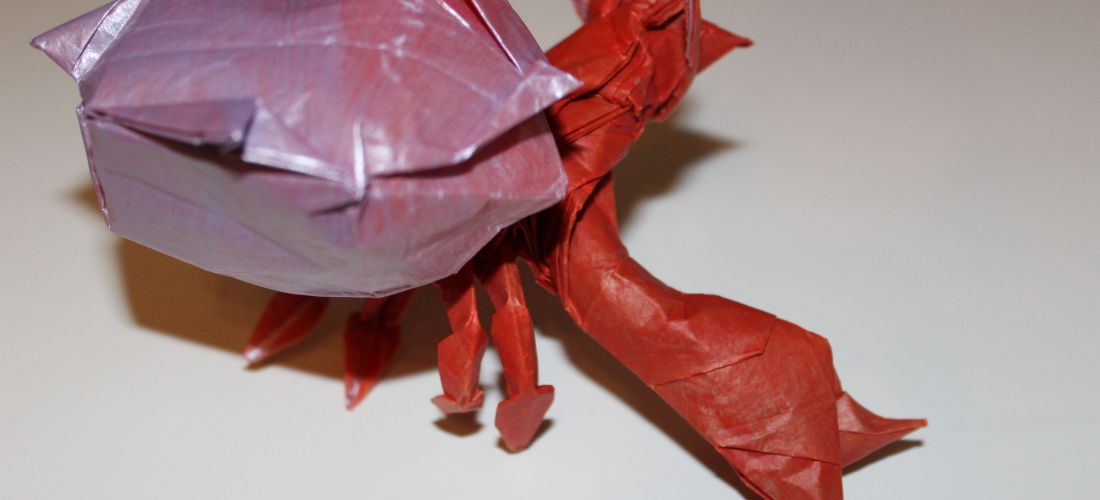
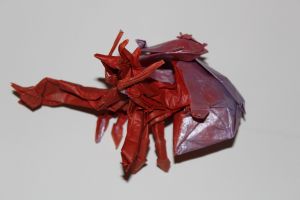
Turban Shell, the eighth model of the book, is based on the horned turban gastropod. That’s why there’s a swirly inside the shell; that’s the little animal that built the shell. Apparently, they can become demons according to Japanese mythology (sazae-oni), but I don’t really know about them.

WOSK_208 - TURBAN SHELL (2) WOSK_208 - TURBAN SHELL (4)

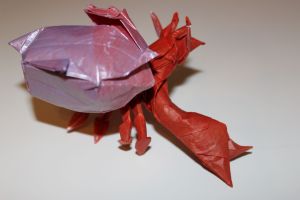
After they die, hermit crabs can use the shell for protection. I can’t think of any other animals that do that, but there must be some.

WOSK_208B - HERMIT CHOCOBO (1) WOSK_208B - HERMIT CHOCOBO (3)

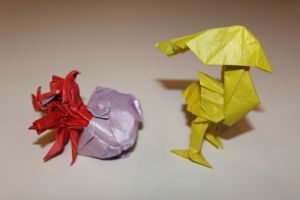
I initially made the Hermit Crab from the thicker paper (not a great idea), so some of the details were lost. Since I was going to have to make it again, I decided to use larger, medium-thick paper to get all the details right. I guess that kind of goes against the theme of this whole series, but I don’t really want to make it again again at the moment.

WOSK_209 - HERMIT CRAB (103) WOSK_209 - HERMIT CRAB (106) WOSK_209 - HERMIT CRAB (105) WOSK_209 - HERMIT CRAB (104) WOSK_209 - HERMIT CRAB (110) WOSK_209 - HERMIT CRAB (109)

All the images with the crab alone are not to scale (above), but the two pictures with the chocobo have the thicker, 27.9 cm paper and show the size of the hermit crab with the consistent scale (below).

WOSK_209 - HERMIT CRAB (101) WOSK_209 - HERMIT CRAB (102)

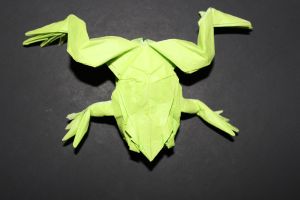
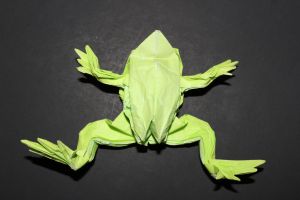
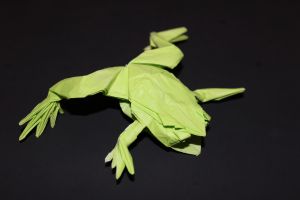
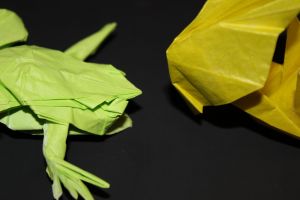
Model 10 is a Tree Frog and does not share similarities to other models in the book like the previous two models. (That is, unless some frogs use gastropod shells like hermit crabs. But that seems unlikely, as it would hinder their legs. A frog could wear a tiny shell as a hat, though, to be fashionable. It could happen. What was I talking about?)

WOSK_210 - TREE FROG (2) WOSK_210 - TREE FROG (3)

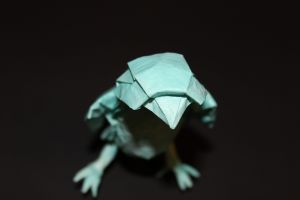
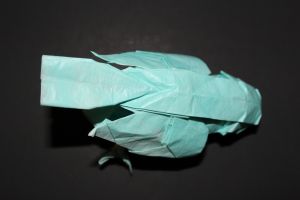
This model also uses 3D more extensively. It also has great toes on all four feet. The nose looks different from the original because I changed it a little to fold something in there as a lock. This also makes the eyes look a little odd, but I think he still looks ok.

WOSK_210 - TREE FROG (5) WOSK_210 - TREE FROG (7)

WOSK_210 - TREE FROG (8)

WOSK_210 - TREE FROG (9)

Puchi Fighter

Origami, Original Designs

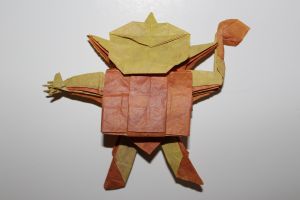
Another Puchi Dragon Quest monster is the Puchi Fighter. He is the warrior class leaf dude.

WKO_006 - PUCHI FIGHTER(101) WKO_006 - PUCHI FIGHTER(102) WKO_006 - PUCHI FIGHTER(103)

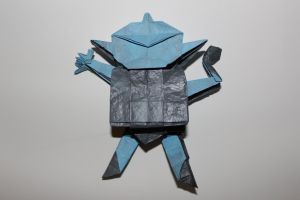
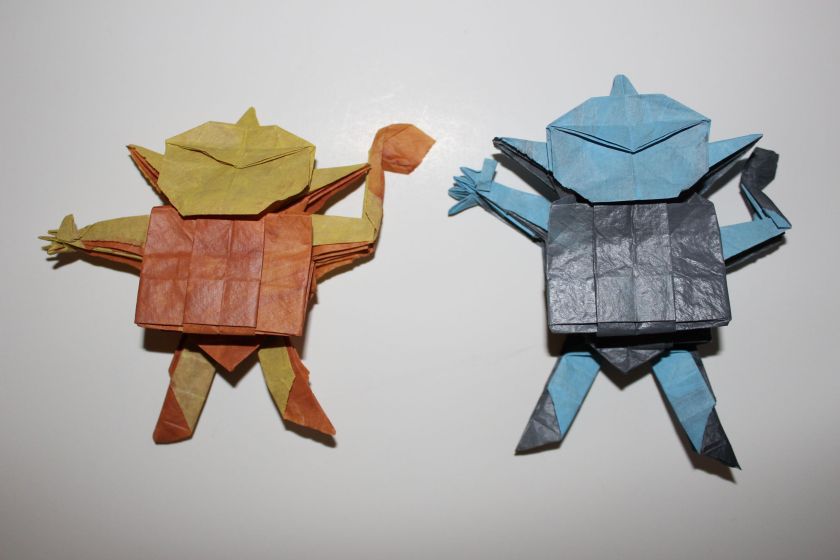
His yellow versions are the プチファイター (Puchi Fighter), FoFightr, and Conkerer in the DS version of Dragon Quest V. The blue/grey ones are コロファイター (Koro Fighter), PodFightr, and Battle Pip. I really don’t get why they decided to rename the Koro Hero to Pip Fighter and the Koro Fighter to Battle Pip. I guess it doesn’t make much difference when the yellow/green ones are all Conk-puns, but I still don’t get the name shell game. Is “Battle Pip” a thing? Like an expression or brand of cola?

WKO_006 - PUCHI FIGHTER(105) WKO_006 - PUCHI FIGHTER(106)

I actually made this one last (after the Puchi Mage). I couldn’t get the hat colour changed, but I’d really need 3 colours to do it justice anyway. I do like how the hat and colour change turned out. Also, an axe is extremely hard to make out of paper.

WKO_006 - PUCHI FIGHTER(107)


Scaled Works of Satoshi Kamiya 2 06-07

Origami, Scaled Works of Satoshi Kamiya

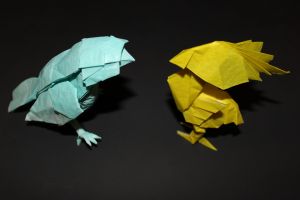
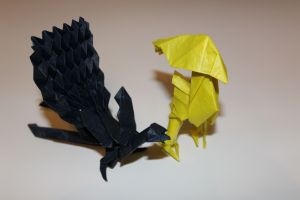
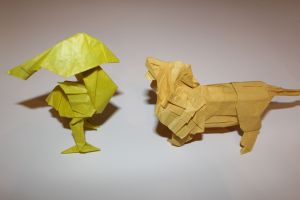
I’ve been wondering if there’s a more consistent way to open these. Like a form letter. Or at least the same paragraph at the front. Oh well. These models are from Satoshi Kamiya’s second “Works” book, are all made from squares with 29.7 cm long edges, and are shown by The Yellow Bird model from his first “Works” book at the same scale to compare model size.

WOSK_206 - LITTLE BIRD (1) WOSK_206 - LITTLE BIRD (3) WOSK_206 - LITTLE BIRD (5) WOSK_206 - LITTLE BIRD (6)

WOSK_206 - LITTLE BIRD (8)

“Little Bird” is the sixth model in the book. While many of his models become 3D near the end, the 3D in this one is much more important to the model and comes up a bit earlier. A lot of the details must be developed while the model is already 3D, particularly the legs, so it’s a pretty interesting model to fold.

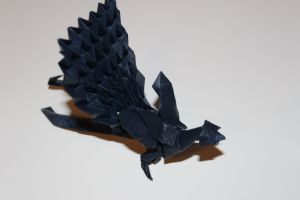
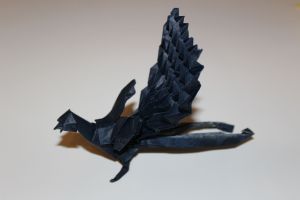
WOSK_207 - LYREBIRD (1) WOSK_207 - LYREBIRD (2) WOSK_207 - LYREBIRD (3) WOSK_207 - LYREBIRD (4)

WOSK_207 - LYREBIRD (5)

A Lyrebird is the following model. I mixed the blue-grey too dark, so, sorry if the details are hard to make out. It has the fancy tail, the two large side tail feathers, an open beak, wings that are a bit open, and tiny little feet. Mine appears to be doing the splits. Yeah, well, he has spirit, I suppose.

Crease Pattern Challenge 013

Crease Pattern Challenge, Origami

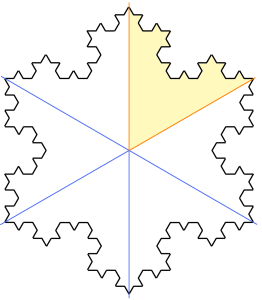
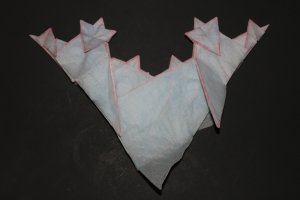
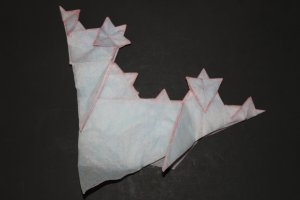
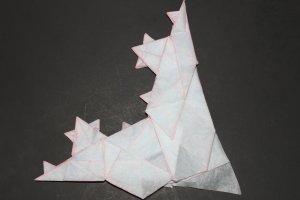
Koch’s Snowflake is a fractal curve and the third iteration is the 13th Crease Pattern Challenge, designed by Ushio Ikegami. This one gave me a lot of trouble, but I wasn’t sure why. There are some tricky points, but it’s pretty straightforward overall. It is simply too intricate for me to fold at the scale I was trying. Instead, I ended up folding just the crease pattern presented, which is only 1/6th of the snowflake.

koch snowflake (108) - Copy OTMCP_013 - KOCH SNOFLAKE - IKEGAMI (1)

OTMCP_013 - KOCH SNOFLAKE - IKEGAMI (2) OTMCP_013 - KOCH SNOFLAKE - IKEGAMI (3)

This one has me on the fence, because I like a more spectacular result with this much effort. On the other hand, fractals are cool, and his inner detailing of triangles makes this a really elegant model. Anyway, the other 5 sixths are all identical (and so have no additional details), so I’m counting this as done. I will talk about this fractal tho.

A fractal is something with a pattern that repeats as you zoom in. An example of a 3D fractal is a Menger sponge, where you divide a cube into 27 equal sub-cubes, remove the center cube and middle cube of each face, and repeat on all the remaining cubes. Taken to infinity, this has infinite surface area and no volume. Also, the first iteration looks the same as a void cube puzzle and was featured in a Pokemon game.

menger0123

To construct the Koch’s curve, we take a line (of a triangle for the snowflake). For the first iteration, you divide the line into 1/3rds, remove the middle 1/3rd, and replace it with the other two sides of an equilateral triangle it would have been a part of (going out in the snowflake form). Every subsequent iteration takes each remaining straight line and repeats the process on all of them.

koch2.gif

koch snowflake (108).png

The whole snowflake starts as a triangle. I’m not animating it too tho.

Crease Pattern Challenge 012

Crease Pattern Challenge, Origami

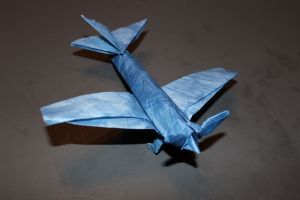
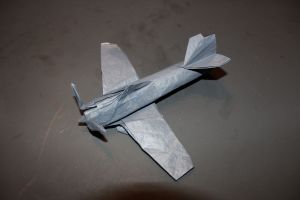
The next Crease Pattern Challenge is Noboru Miyajima’s Propeller Plane. I’m a big fan of his models but not so much his crease patterns. His previous Crease Pattern Challenge, “Knight on a Pegasus”, was a little vague, so I had to fold it from the diagrams given in a later Tanteidan Magazine then go back and finish the details on the crease pattern one. His website has a lot of crease patterns, but the ones I’ve tried similarly don’t have many details.

OTMCP_012 - PROPELLER PLANE - MIYAJIMA (4) OTMCP_012 - PROPELLER PLANE - MIYAJIMA (5)

I finished the propeller plane without much trouble, but it looked a little different than the pictures. So I found the diagrammed model in Tanteidan Convention Book 7, folded it, and then compared it. Apparently, I did all right; I just shaved off the back fin. The crease pattern on is in blue, and the diagrammed on is grey.

OTMCP_012 - PROPELLER PLANE - MIYAJIMA (2) OTMCP_012 - PROPELLER PLANE - MIYAJIMA (3) OTMCP_012 - PROPELLER PLANE - MIYAJIMA (1)

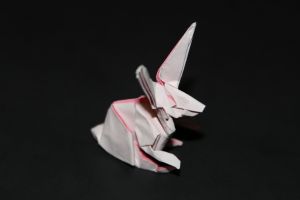
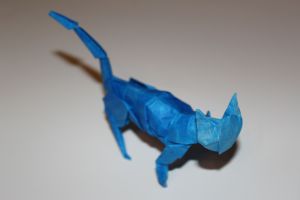
I looked up some of his other models to include here. I’ve got a Rabbit from Tanteidan Magazine 53, and a Cat from Tanteidan Convention Book 8 below.

MIYAJIMA - RABBIT (2) MIYAJIMA - RABBIT (3) MIYAJIMA - RABBIT (1) MIYAJIMA - CAT (3) MIYAJIMA - CAT (2) MIYAJIMA - CAT (1)

I’m having trouble with the next Crease Pattern Challenge, “Koch’s Snowflake”. I wonder if maybe I should just skip around. I do have some of the other ones done already.

Scaled Works of Satoshi Kamiya 2 04-05

Origami, Scaled Works of Satoshi Kamiya

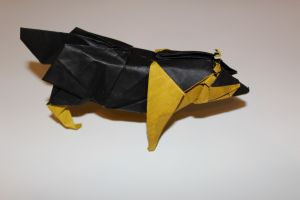
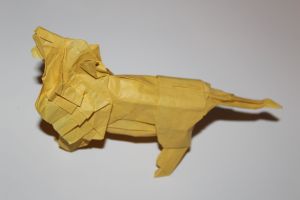
The next couple of models from Kamiya’s second book are a Raccoon Dog and a Lion.

The Raccoon Dog is listed in Japanese as Tanuki, which is also a word in English. I wonder if they didn’t use it because Super Mario Bros. 3 helped popularize the word in English but spelled it “tanooki”. Or maybe they just didn’t think it was popular enough for people to recognize. But how many people recognize “Cyclommatus metallifer”, anyway?

WOSK_204 - RACCOON DOG (1)

WOSK_204 - RACCOON DOG (2)

WOSK_204 - RACCOON DOG (3)

WOSK_204 - RACCOON DOG (4)

Moving on, Kamiya’s tanuki has a great raccoon-esque colour change and adorable little ears. It does not turn into a Jizou statue (that I am aware of).

WOSK_205 - LION (2)

WOSK_205 - LION (3)

WOSK_205 - LION (4)

WOSK_205 - LION (7)

The Lion is one of the more grandiose models in the book, not that there are a lack of them. The regal countenance and fancy mane make it much more memorable than other origami lions. You may have noticed that, with the details, I had to go back to the thinner paper. The head gave me a bit of trouble, but the mane and face are pretty slick.

WOSK_204 - RACCOON DOG (5) WOSK_205 - LION (8)

Puchi Priest

Origami, Original Designs

The second Puchi leaf dude I made was the Puchi Priest. The priest is the cleric/healer of the group (both with this monster and with character classes in Dragon Quest games). This is why he has a cross (and possibly a pope-ish hat).

WKO_004 - PUCHI PRIEST(102) WKO_004 - PUCHI PRIEST(103)

The green variations are プチプリースト(Puchi Priest), FooPriest, or Conkuisitor, while the blue editions are コロプリースト(Koro Priest), PodPriest, or Epipany (names from the Japanese, English SNES, and English DS editions of the games).

WKO_004 - PUCHI PRIEST(105) WKO_004 - PUCHI PRIEST(108)

I mentioned I was going to go over the names a bit, but I’m actually not so sure about the English names. I have no idea about Foo, Conk, or Pip, which recur in the English names. I think Pod refers to “pod people”, which are plants that replace humans in Invasion of the Body Snatchers and Invasion of the Body Snatchers. Not sure tho.

Anyway, the Japanese names are プチ (Puchi) and コロ (Koro). Puchi is just a word for small/petit. Koro is more interesting; it’s from コロポックル (koropokkuru), which are little spirit people who live under plants in Ainu legend. I like little spirit people over alien abductors by far.

WKO_004 - PUCHI PRIEST(110)