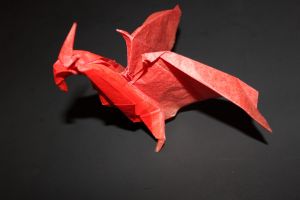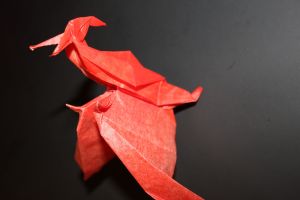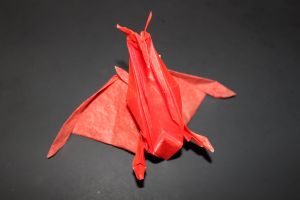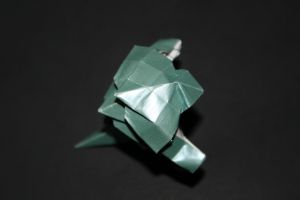
Crease Pattern Challenge 025

Crease Pattern Challenge, Origami

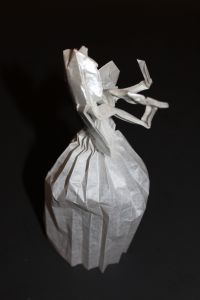
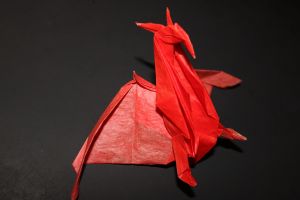
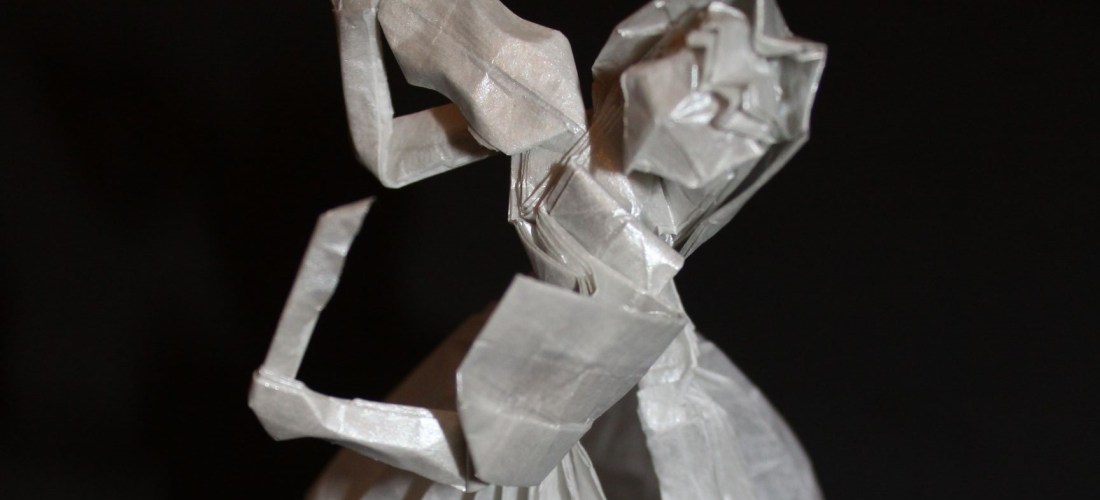
Takashi Hojyo is another one of those folders with a lot of Crease Pattern Challenges, for obvious reasons. Challenge 25 in Origami Tanteidan Magazine 79 is his Violinist.
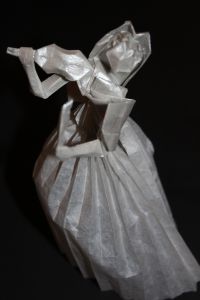
otmcp_025-violinist-hojyo-1 otmcp_025-violinist-hojyo-4 otmcp_025-violinist-hojyo-5

His models tend to be a series of points you shape afterward. Usually, it’s a bit more obvious, but the violin, hands, and sleeve as well as the face and hair are pretty similar. It’s lucky for me the pattern has what’s what listed on it for reference. What really threw me, especially with the head, was the polarity switch in the dress that I almost missed. It’s shown clearly, but sometimes I just take off too fast on things like this.

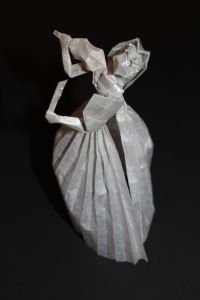
otmcp_025-violinist-hojyo-6 otmcp_025-violinist-hojyo-7

otmcp_025-violinist-hojyo-3

Crease Pattern Challenge 024

Crease Pattern Challenge, Origami

I think I hate this sheep.

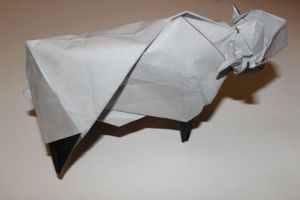
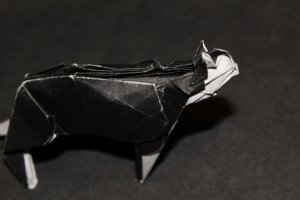
Challenge 24 in issue 78 is Seiji Nishikawa’s Sheep. It’s a fairly simple model, but the crease pattern is not. I get that it’s a “challenge”, but, when there are other entries that are less confusing and get you things like a bad-ass dragon, this much work for this sheep is just frustrating. Anyway, my first go wasn’t so good.

otmcp_024-sheep-nishikawa-101

I didn’t go back to it for awhile. When I did, I copied, expanded, and quartered the pattern. I folded each part and connected them afterwards to find out how to fold the model. Except for one of the two identical quarters, leading to this Franken-sheep.

otmcp_024-sheep-nishikawa-102

otmcp_024-sheep-nishikawa-103 otmcp_024-sheep-nishikawa-104

So Frankenstein is a last name, and the monster is kind of related to Viccy (I mean, he created him), so wouldn’t the monster’s name… wait, what were we talking about? Oh, right. This bloody sheep.

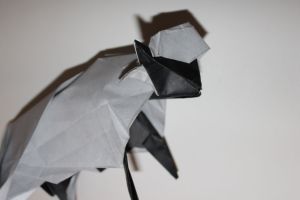
I already had all the reference points; the only problem was that the ears and legs came together in a crazy way. With the cobbled together one, I got the final sheep folded.

otmcp_024-sheep-nishikawa-112 otmcp_024-sheep-nishikawa-107

otmcp_024-sheep-nishikawa-109 otmcp_024-sheep-nishikawa-110

otmcp_024-sheep-nishikawa-111 otmcp_024-sheep-nishikawa-113

I do like the nose a lot, but I think this would be better served with diagrams.
Crease Pattern Challenge 023

Crease Pattern Challenge, Origami

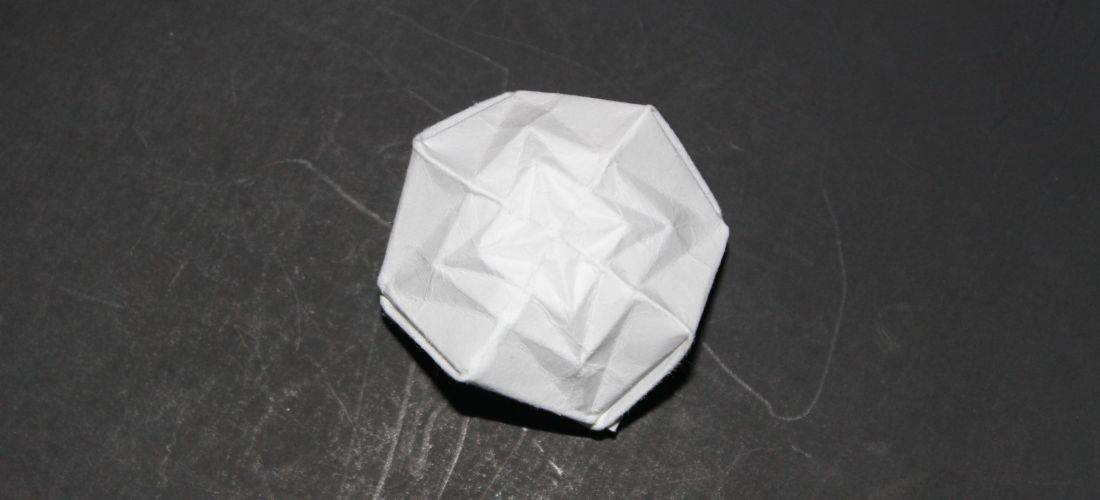
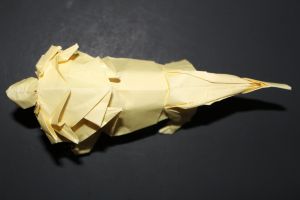
Crease Pattern Challenge 23 is a Heptadecagonal Tato designed by Seishi Kasumi. A tato is a flat container for stamps and stuff.

otmcp_023-heptadecagonal-tato-kasumi-1

otmcp_023-heptadecagonal-tato-kasumi-4 otmcp_023-heptadecagonal-tato-kasumi-2

I did this one by making a blown up copy (you can see the lines). There are actually instructions for how to get the necessary lines on a page, and I started with that. First, I got the paper to 9 by 17, then I started the initial reference folds, and then wow. It wouldn’t be that tedious (especially looking at previous models), but the number of reference lines with respect to the final applied lines was something. It had at least double the lines radiating out from the center, and all the edges were folded completely. I decided to print it for time and so it wouldn’t have all the extra creases.

After all that, this was kind of fun. I always like things that collapse together.

otmcp_023-heptadecagonal-tato-kasumi-5 otmcp_023-heptadecagonal-tato-kasumi-3

Crease Pattern Challenge 022

Crease Pattern Challenge, Origami

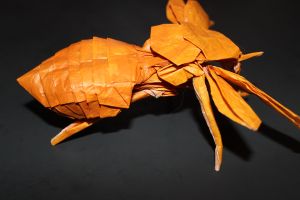
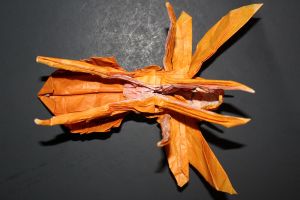
This is another crease pattern by Satoshi Kamiya, and it’s easy to see why they use his models so much. #22 is simply called “Vespid”, which is a wasp but not a specific wasp (such as a German Yellowjacket).

otmcp_022-vespid-kamiya-112 otmcp_022-vespid-kamiya-111

otmcp_022-vespid-kamiya-106 otmcp_022-vespid-kamiya-104

otmcp_022-vespid-kamiya-109 otmcp_022-vespid-kamiya-107

This is the kind of crease pattern I like. The less straightforward parts don’t feel like they’re there just to mess with you. The details aren’t too far extrapolated from the pattern and even invite you to interpret them how you like. Wasps creep me out a bit, but I still enjoyed folding this and love the outcome.

On the flip side, since I knew I was working toward a model that looks so interesting, I probably glossed over any problems I would complain about in other crease patterns.

otmcp_022-vespid-kamiya-108 otmcp_022-vespid-kamiya-102

otmcp_022-vespid-kamiya-105

Crease Pattern Challenge 021

Crease Pattern Challenge, Origami

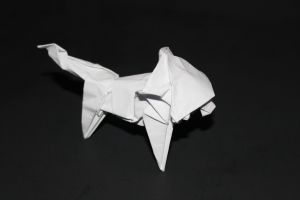
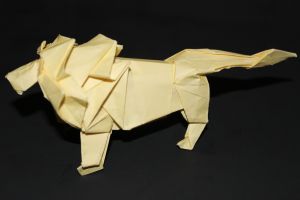
So, this is an interesting one. Crease Pattern Challenge #21 is Hideo Komatsu’s Lion in issue 75. I kept screwing up the reference points (there were several close ones that I kept mixing up) and, after trashing a few papers, made a copy of the pattern and folded that.

otmcp_021-lion-komatsu-2 otmcp_021-lion-komatsu-1

otmcp_021-lion-komatsu-3

This seems mostly correct, but there is a large problem with the mane. Luckily, there are diagrams of this model in Works of Hideo Komatsu, so I folded that one for reference.

komatsu-lion-1 komatsu-lion-2

komatsu-lion-3 komatsu-lion-4

komatsu-lion-5

Apparently, I just didn’t flip the front of the mane back. The fold back line isn’t actually in the crease pattern (it would probably be pretty confusing to include, so it’s one of those interpretive parts). In any case, I’m counting my less detailed, more derpy lion. I also found out I already folded this model (99% sure from diagrams), so here it is in the kind of paper I usually use.

komatsu-lion-7 komatsu-lion-6

komatsu-lion-8

Crease Pattern Challenge 020

Crease Pattern Challenge, Origami

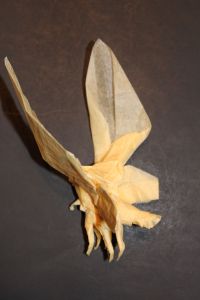
Challenge 20 in issue 74 is a Butterfly by S-Taro.

otmcp_020-butterfly-staro-1 otmcp_020-butterfly-staro-2

I hope this is discernible enough with the cream paper (I can see it, but I folded it). It’s nice, specifically the nose and fluffy ears (or whatever those are in insect). I tried to look up some of his other models, but I can’t really find him. What I think is his website has some Japanese but is mostly characters my computer can’t discern. This might be the page of his stuff, but I can’t be sure because my computer displays the text as gibberish. The insects are great (the cranes are pretty creepy though). I wonder if he goes by his full name or something now.

otmcp_020-butterfly-staro-4 otmcp_020-butterfly-staro-3

Crease Pattern Challenge 019

Crease Pattern Challenge, Origami

This is the first of several Crease Pattern Challenges in one day (see Challenge 27 here for more info). I didn’t fold them on the same day, just put them here. I think. I’m pretty sure.

This is Challenge 19: A Regular Tetrahedron with a Hyperbolic Paraboloid by Satoshi Kamiya. You may ask, “What is a tetrahedron?” Well, “tetra” means four, and “hedron” means bases or something. “Regular” implies that all the faces are the same and have the same angles when making the polygon. So it’s a pyramid.

otmcp_019-tetrahedron-kamiya-2 otmcp_019-tetrahedron-kamiya-3

That should be boring, but it was made by Satoshi Kamiya. The “hyperbolic paraboloid” is the interesting part. This is essentially a saddle-shaped surface, and he put it in the center of the square to cause it to fold in to the tetrahedron. Here it is pulled out and collapsing back.

otmcp_019-tetrahedron-kamiya-4 otmcp_019-tetrahedron-kamiya-6

otmcp_019-tetrahedron-kamiya-7 otmcp_019-tetrahedron-kamiya-8 otmcp_019-tetrahedron-kamiya-9

While it initially looks boring, it’s pretty interesting and a little trippy.

Crease Pattern Challenge 018

Crease Pattern Challenge, Origami

Tanteidan’s 18th crease pattern challenge is a little different and pretty neat. Masashi Tanaka made four variations of the traditional orizuru crane model. The first two, labeled “A” and “B”, have squared backs, with B having twice as tall a back as A. B also makes me think it would make a good hat, but I have no idea why.

otmcp_018-orizurus-tanaka-103 otmcp_018-orizurus-tanaka-102

otmcp_018-orizurus-tanaka-104 otmcp_018-orizurus-tanaka-105

N is more complex than the others (I still like C more), with a normal crane back but cubes for wings.

otmcp_018-orizurus-tanaka-106 otmcp_018-orizurus-tanaka-107

C is my favourite of these. Its back is a cube. My folding of these last two didn’t end up as well locked into place as the examples, so I also have this one’s base clamped to show how the cube should look. I let the bases do whatever because I liked how it looked, but Tanaka’s examples seem to have shorted bases. I wonder if that would help lock them.

otmcp_018-orizurus-tanaka-108 otmcp_018-orizurus-tanaka-109

otmcp_018-orizurus-tanaka-110 otmcp_018-orizurus-tanaka-111

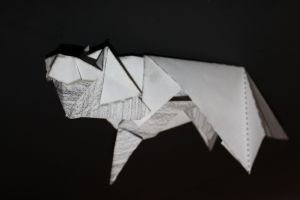
I also have a couple more Tanaka models: his Cat from diagrams in Tanteidan magazine #95 and Rat from Tanteidan #106.

otm_095-cat-tanaka-1 otm_095-cat-tanaka-3

I had trouble with the cat’s face, but it’s an interesting way to make it, with the sides seeming to imply whiskers from the nose. For some reason, feline faces are pretty hard to do well in origami. My main problem was if the bottom flap was for a mouth and how to shape it.

otm_106-nezumi-dash-tanaka-2 otm_106-nezumi-dash-tanaka-1

Tanaka’s Nezumi DASH! has a pretty unique starting step to help keep the model free of random creases. Some of the initial precreases are done on an alternate square (of the same size) then transferred to the model square by lining the two up. I was surprised. The DASH! is because if you squeeze his tail up to his body and let go, his tail will propel him forward.

Crease Pattern Challenge 017

Crease Pattern Challenge, Origami

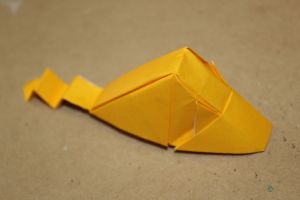
The 17th Challenge is a Suppon designed by Shinji Sasade. This is another in the growing list of models I took only a couple of pictures of and then promptly lost. Unlike some of the others, I think 2 pictures give a pretty good idea of this model.

OTMCP_017 - SUPPON - SASADE (1) OTMCP_017 - SUPPON - SASADE (2)

This is because the model is extremely well designed. While you could argue that this model is more simple than some of the more complex challenge models, it’s so ingenious that it’s hard to tell where the edges are. With both the shell and belly so well developed, this is a great 3D model.

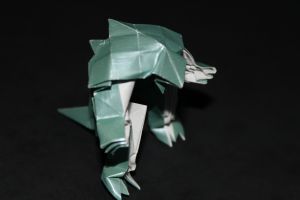
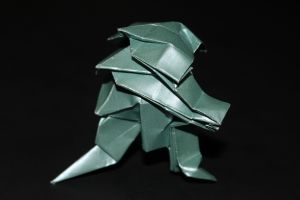
He also likes to make kaijuu origami. Among them, Sasade has made Radon (diagrammed in Origami Tanteidan Convention Book 5) and Gamera (listed as Turtle-Kaijuu in Convention Book 10).

SASADE - RADON (103) SASADE - RADON (104) SASADE - RADON (101) SASADE - RADON (105) SASADE - RADON (102)

I like Radon, but he kind of looks like a parrot to me. I guess he always has though. Also, about that link: 1) looks like he didn’t skip leg day in the recent movies, and 2) he’s “Rodan” in English now? Like, the sculptor? Has he always been Rodan in English?

SASADE - KAME-KAIJUU (104) SASADE - KAME-KAIJUU (103)  SASADE - KAME-KAIJUU (107) SASADE - KAME-KAIJUU (111)

I made Gamera from paper that is too small (again), so I had to improvise some of the details to be less complicated. But I had this really nice shiny paper that I wanted to use. It kind of worked out, because it helped the strong, round shell design.

SASADE - KAME-KAIJUU (105) SASADE - KAME-KAIJUU (106) SASADE - KAME-KAIJUU (102)

Crease Pattern Challenge 016

Crease Pattern Challenge, Origami

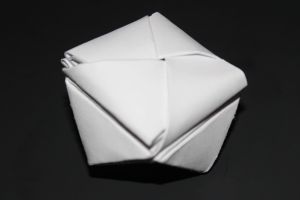
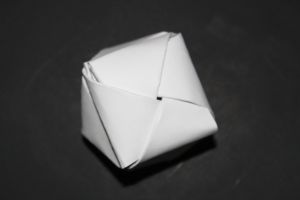
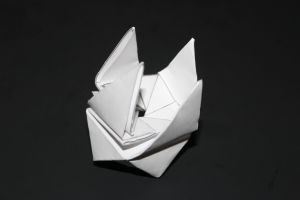
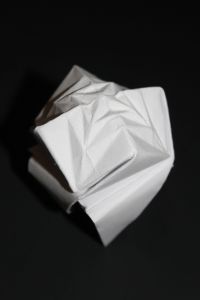
This one is a little bit outside of what I normally make. Challenge 16 is King PolyPouches by Chris Palmer. He has his own website and a book that show some of his work. He typically uses inscribed geometries to bend paper into different neat objects. This can require thicker paper (which is why I shy away from it) for the structures to hold their shapes. The style can give you some beautiful and fascinating objects.

OTMCP_016 - KING POLYPOUCHES - PALMER (101) OTMCP_016 - KING POLYPOUCHES - PALMER (103) OTMCP_016 - KING POLYPOUCHES - PALMER (105) OTMCP_016 - KING POLYPOUCHES - PALMER (106)

For the model, I used cardstock and drew the crease pattern on the inside. Cardstock may have been too thick for this scale, but you can still see the geometric pattern that rounds the base. A benefit of using paper that’s too thick turned out to be that it can stand on its own closing flaps and looks kind of like a jellyfish that way. It’s even elegant as a jellyfish.

OTMCP_016 - KING POLYPOUCHES - PALMER (107) OTMCP_016 - KING POLYPOUCHES - PALMER (111) OTMCP_016 - KING POLYPOUCHES - PALMER (113)

OTMCP_016 - KING POLYPOUCHES - PALMER (112)